

Restless legs syndrome: an uncontrollable agitation that tramples on sleep
Like agitation at night, movements during the day, jerks in the legs during a moment one would want calm and restful. This is how restless legs syndrome imposes itself on those who suffer from it: a lack of peace caused by a loss of control of the lower limbs, accompanied by unpleasant sensations in them. What could happen for such a phenomenon to disturb this part of our body like this?
Legs that don't rest, we prefer when it happens in other circumstances, such as taking a nice walk in nature, or tapping your feet to the beat while listening to music you love, well rhythmized.
Here, obviously no pleasure or interest. This neurological disorder can be likened to a sleep disorder, as it can disrupt the nights of some people and impair the quality of sleep. What exactly do we know about restless legs syndrome? What are the causes of these restlessness in the legs? We have looked into this thorny subject, so don't run away, and discover everything you need to know about SJSR!
What is called restless legs syndrome?
Restless legs syndrome ("RLS"), also called Willis-Ekbom disease, is a chronic disorder characterized by an irresistible need to move the legs, to shake them, while feeling sensations like tingling or pins and needles in them. These highly unpleasant sensations, sometimes even resembling burning on the skin, leave little respite for those who suffer from them. RLS manifests, moreover, during moments... of rest! And that is precisely the problem: attention is focused on these disturbing sensations and the resulting leg movements. Moments of calm thus turn into torment, whether at night when trying to sleep, or when sitting (at the office, at home, or worse, in a car or on a plane for example), sometimes without being able to stretch the legs.
The discomfort felt in the lower limbs causes this impatience in the legs, which is expressed by the physical discomfort of its irresistible movements as well as by psychological distress and increased fatigue: there are significant difficulties in resting at night or staying in a seated position during the day. It is the whole body and mind that are then restless. You are probably wondering if this phenomenon is widespread?
The figures of restless legs syndrome
RLS is not a very "popular" disease, in the media sense of the term, whereas according to the "Ameli" website, it affects 8.5% of the French population1, which is not insignificant. A French study from 20052 supports this figure. The prevalence rate of restless legs syndrome is generally confirmed by the referenced site of the "Fondation Sommeil", which estimates it between 5 and 10% of the adult population3.
However, a cross-sectional study published in 20124 in the highly respected “Sleep Medicine Reviews” considers that if frequency criteria (at least twice a week) and severity are taken into account, RLS would affect “only” 2.2 to 7.9% of the general population. Moreover, by adding a differential diagnosis to these criteria, the prevalence would then be between 1.9 and 4.6%.
Moreover, various studies5 show that leg restlessness would concern women more than men (10% for ladies versus 5% for gentlemen), and that this disorder tends to decrease after age 64. Unfortunately, patience is therefore required for some people facing this neurological disorder!
Finally, it is interesting to note that according to another study published in 20076, about 2% of children between 8 and 17 years old would be affected by RLS, and 25% of adults who suffer from it would have been victims since their childhood (between 8 and 17 years).
As one can see, Willis-Ekbom disease, in other words RLS (just to make sure you're following!), affects more people than one might assume. Hence this inevitable question: why?
What are the causes of restless legs syndrome?
Unlike other sleep disorders, as well as certain parasomnias or pathologies, the causes of restless legs syndrome are relatively well identified. Physiologically, the lack of dopamine in the brain and spinal cord is implicated, as well as an iron deficiency, whether caused by anemia or not.
Furthermore, doctors and scientists agree that there are 2 types of RLS7:
- primary restless legs syndrome: idiopathic (no known cause) or genetic (often early onset)
- secondary restless legs syndrome: these secondary restless sensations are associated with certain pathologies, situations, or behaviors
Thus, doctors have found a link between these secondary restless sensations and the following cases:
- chronic kidney failure, multiple sclerosis
- hypothyroidism, diabetes, Parkinson's disease
- pregnancy (20 to 30% of women experience RLS during pregnancy)
- use of certain medications: antidepressants, neuroleptics, antihistamines
- alcohol or tobacco consumption, coffee/tea or chocolate consumption
- stress, fatigue
Finally, the factor of obesity or overweight is also to be considered in the onset of restless legs syndrome. A 2009 study8 shows that the risk of being affected by RLS increases with overweight.
What are the symptoms of RLS?
The symptoms of restlessness in the legs are truly characteristic of this disorder, which mainly occurs during periods of rest, namely in the evening or at night, as well as during prolonged sitting (office, car, plane…). These rest times are no longer restful when RLS manifests, and people affected during the day (while sitting) are then forced to get up and walk to relieve these symptoms somewhat, which are as follows:
- unpleasant sensations (restlessness) but not painful in the lower limbs: tingling, prickling, burning sensations
- an irresistible need to move the legs
- [5]
- partial or total relief of symptoms through leg movements or walking
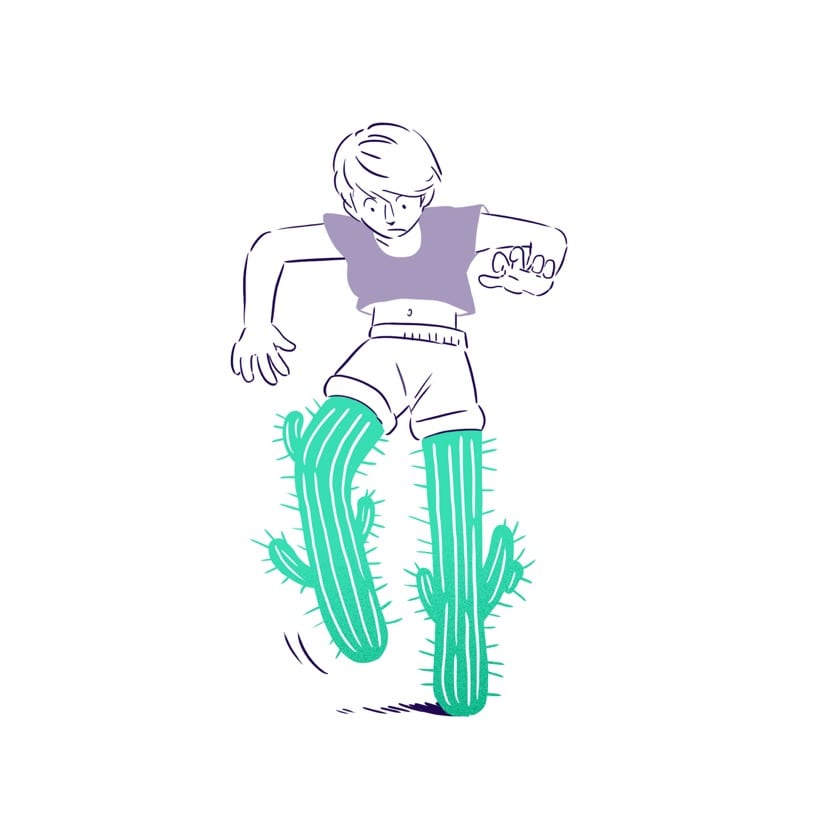
![[3]](https://www.hackademy.care/img/illustrations/Sleep_Hackademy_Hoobooh_Jambes_sans_repos_2.jpg "Un trouble du sommeil très impatient !")
How can restless legs syndrome be diagnosed?
The questionnaire with a doctor is the basis for diagnosing RLS. It helps determine if the symptoms, frequency of episodes, family history, or medication use can lead to identifying this neurological disorder. It is essentially by describing their symptoms to the doctor that the latter can establish a diagnosis for the patient.
Sometimes, as with certain sleep disorders, it is possible to highlight the restless legs syndrome through an examination called polysomnography. It consists of a sleep analysis during which different variables such as respiratory rate, heart rate, an electroencephalogram, or an electromyogram of the arm or leg muscles are recorded. However, the use of polysomnography in the case of RLS is not systematic.
Moreover, since the relationship between iron deficiency and RLS is often highlighted, it is advisable to check the ferritin level in the blood, which can help diagnose restless legs syndrome.
Since RLS symptoms can sometimes be confused with those of other neurological pathologies (akathisia, neuropathies, paresthesia, cramps…) or vascular ones (deep venous insufficiency or “heavy legs,” for example), additional tests, a blood test, or consultation with a neurologist may be necessary in some cases when differential diagnosis proves complicated.
How to treat restless legs syndrome?
Unfortunately, treating the causes of RLS is not always possible, nor is preventing this neurological disorder. However, symptomatic drug and/or non-drug treatments can reduce or eliminate some aggravating factors, as well as some restlessness related to diseases or deficiencies (iron or dopamine among others).
Thus, depending on the intensity of the syndrome assessed by the doctor (mild, moderate, severe, or very severe), based on the nature of the symptoms and the level of social and moral impact, here are some possible symptomatic treatments that can relieve RLS. First of all, for the mildest forms, non-pharmacological treatments can be considered:
- adopt a healthy and appropriate lifestyle: fixed bedtime, light physical activities or stretching before going to bed, avoid taking tea/coffee/chocolate and alcohol in the evening
- leg massage or application of warm compresses, taking a hot bath (with a nice scented foam, even better!)
- focus on a playful or relaxation activity: reading, manual activity, but also using Dodow or Hoomband
- engage in regular physical activity (walking at the end of the day)
On the other hand, medication treatments, with their risks of undesirable side effects, can be used to limit the scope of sensorimotor symptoms or sleep disorders related to RLS, or to alleviate (or even cure) a disease that would be the cause of leg restlessness:
- taking iron or folic acid supplements, taking magnesium
- taking dopaminergic agonists to compensate for the lack of dopamine: pramipexole, ropinirole or rotigotine in a skin patch
- taking opioids, anticonvulsants or non-barbiturate hypnotic sedatives
It should be known that taking dopaminergic agonists can be accompanied by side effects such as nausea, vomiting, low blood pressure, daytime sleepiness, hallucinations and, more rarely, behavioral disorders (for example compulsive buying, but these can occur for other reasons, as you might expect!).
The treatment of restless legs syndrome symptoms has become relatively effective without having to resort to medication, and that is fortunate. Indeed, many doctors report positive results by focusing on lifestyle hygiene, and especially on the regular practice of moderate daily physical activity (walking is recommended!)
What a great way to thumb your nose at this neurological disorder by enjoying a few little dance steps at the end of the day, to annoy it, and thus get some rest for your legs during the following night! Don't you think? This is how restless legs syndrome is treated... by making them work a little!
Sources:
[1] Restless legs syndrome, site « Ameli », 2020 [2] and [5] Epidemiology of restless legs syndrome in French adults: a nationwide survey: the INSTANT Study, F Tison, A Crochard et al, « Neurology », July 2005 [3] Restless legs syndrome, site « Fondation Sommeil », 2020 [4] Epidemiology of Restless Legs Syndrome: A Synthesis of the Literature, Maurice M. Ohayon, Ruth O'Hara et al, « Sleep Medicine Reviews », August 2012 [6] Restless legs syndrome: prevalence and impact in children and adolescents, the Peds REST study, Daniel Picchietti , Richard P Allen et al, « Pediatrics », August 2007 [7] Restless Leg Syndrome, Abeera Mansur, Pablo R. Castillo et al, « Stat Pearls », April 2020 [8] Obesity and restless legs syndrome in men and women, Xiang Gao, Michael A Schwarzschild et al, « Neurology », April 2009